Paul Ricoeur's Hermeneutics: Shifting from Substance to Relation
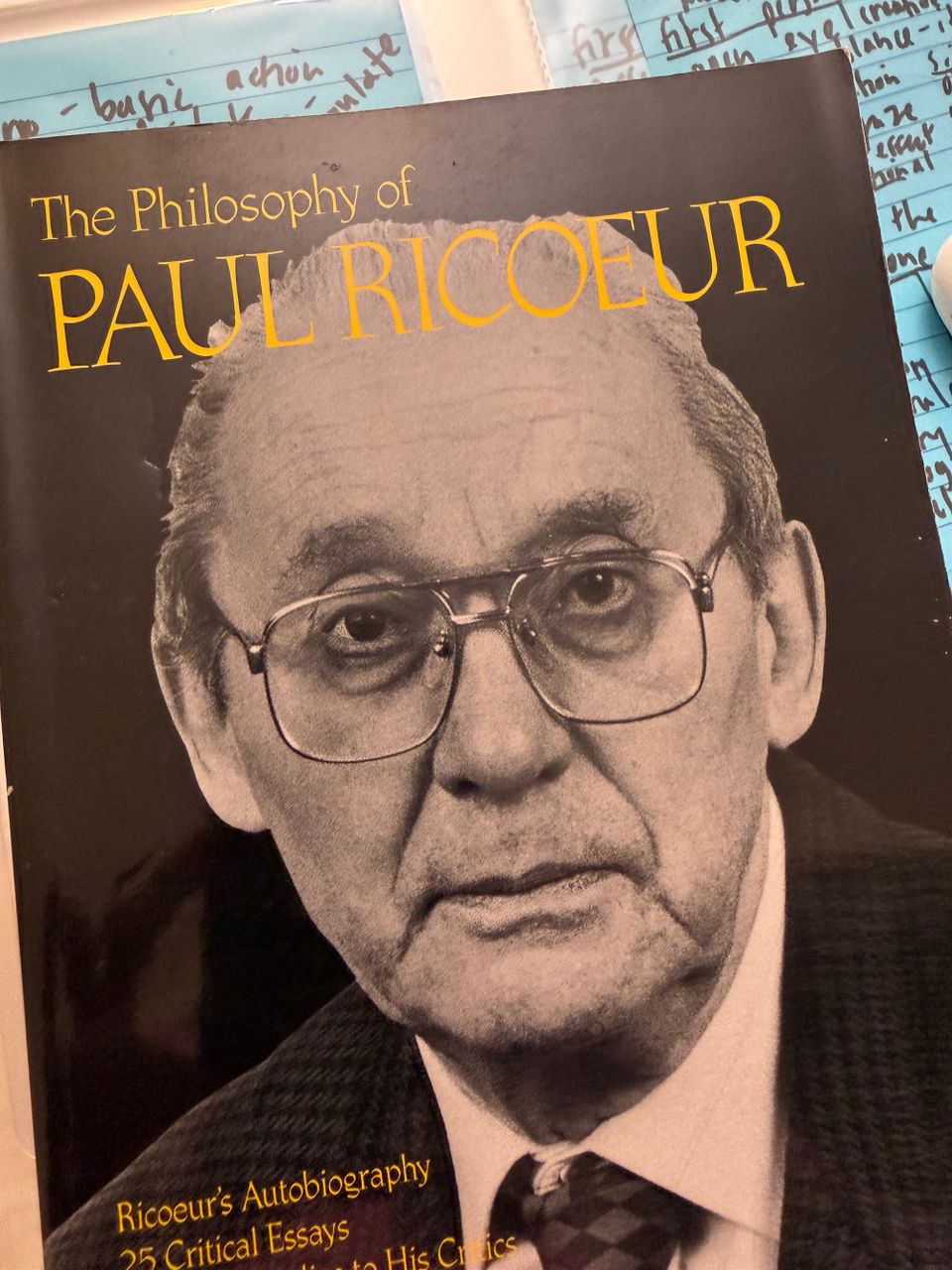
Paul Ricoeur demonstrated the shift from knowing being as it is in-itself, or as it is essentially, in the sense of without relation to a knower, to uncovering being as a process of relational interpretation, specifically the relations of different intentional interpretations, which might be thought of as the shift from the Husserlian "Eidetic" reduction to the Heideggerian "Hermeneutic Circle." Edmund Husserl hoped to disclose the things-in-themselves of the Kantian noumena without the obfuscation of the observer's intention, so that what appeared to us could show itself from its own ground without the interference of our projective presuppositions, which would have meant something like knowing without the distortion of a knower. The concepts of the intention are motivated, so they seem to get in the way of the unmotivated or disinterested knowledge of the Eidetic reduction. However, as Husserl himself discovered, there is no knowledge without ideas and motivated ideas at that, which is the motivation that Heidegger called "care." The investment of located being in knowing is the intention to reveal being to itself through another or through otherness. Without the "eidea" (ideas), or presuppositions of the intention, there is nothing with which to grasp, or form, the object of knowledge. The problem of scientific observation identified as its "theory laden-ness," is that without a theory, there is nothing to direct, or "motivate," the observer's gaze, but theory motivates the observation before-hand in such a way as to make it less "objective" in the strict scientific sense of seeing what happens without any preconceived notions.
The Greek "eido" means to see and is the root of both "idea" and "idein," to have, or in this case to grasp)." A signifier presents the signified through the distantiation of its absence. We cannot see an object without distance from it, so the idea is what makes the referent "visible" on our intentional screen. We know being through the nonbeing or otherness of conceptual possibilities. Martin Heidegger showed that this conundrum of wanting to know without intention, sometimes called the conundrum of "Observer Effect," resulted from having been "thrown" into the "facticity" of a particular body at a particular place and time. The located-ness of "being-there" was both the limit and horizon of knowing for Heidegger.
The limitations of situated-being's knowing is also the horizon of any possible knowing because knowing is intentional, which is to say that knowing is motivated, motivated in the first place by located-being's unknowing about from where it has been thrown, and then motivated in the second place by located-being's unknowing about uncertainty reduction in the evolutionary niche into which it has been thrown. Therefore, all knowing is motivated by care about being and not by knowing itself, or rather, knowing itself is care for being. Ontic beings care about the Being from which they were thrown, which they do not know, as well as the particularities of the situation into which they have been thrown. Ricoeur's great contribution to knowing about being was his formulation of how an observer's situated intention can contributed to an open circle of other, related, intentional situations. The differences of intentional situations require interpretations of being rather than a closed, determinate identification of being-in-itself. Ricoeur's version of the hermeneutic circle was formulated as the circle of "Self as Another," in which each self knows itself through another, or through the indeterminacy of otherness.
Member discussion